
How Much Do Central Budget Sector Employees Cost Us?

Through this infographic, we want to show the real size of the budget sector, i.e. the number of staff units in the central budget sector versus the real sector of the economy. At the same time, we wanted to find out how much the salary of an employee paid from the budget at central level costs each one of us. In 2015, almost 20% of all employees in the country worked in the budget sector, or around 235,000 people, down by 8.9% compared with 2012. Of these, over 66,000 were employed in the central budget sector, and MDL 3.7 billion was spent on their salaries. In 2016, the Ministry of Finance published the number of staff units required and actually employed and paid for the performance of public functions and services at central level. The infographic shows the real size of the budget sector, i.e. the number of staff units in the central budget sector versus the real sector of the economy. It also presents the costs that each one of us covers for the salary of an employee in this sector. Thus, drawing on data on staff units for 2015 and personnel expenditure for the same period, we have tried to present the evolution of these two parameters. The National Bureau of Statistics offers the following definition of the budget sector – all units financed from the state budget, the state social insurance budget, the budgets of administrative-territorial units and from special funds, regardless of sectoral subordination. The institutional units included in the central government sector (S.13), in accordance with ESA 2010 (point 2.112), are the following: (A) government units, which exist through a legal process and have judicial authority over other units in the economic territory, and which administer and finance a group of activities that mainly provide public goods and services intended for the community; (B) a corporation or quasi-corporation that is a government unit, where its output is mainly for public purposes and which is controlled by a government unit; (C) non-profit institutions recognised as independent legal entities that are non-profit producers and are controlled by public administrations; (D) autonomous pension funds, where there is a legal obligation to contribute and where public administrations manage the funds with regard to the settlement and approval of contributions and benefits. Local budget sector – this sub-sector includes those types of public administration institutions whose competence extends only over a local part of the economic territory, with the exception of local agencies of social insurance funds. For easier comparison and a concise graphic representation, we have considered the number of staff units to be equivalent to one employee, although in some cases there are persons who work part-time, so the actual number of employees is higher. Other key figures: Data source: Ministry of Finance, National Bureau of Statistics (see resources) The infographic was produced within the Budget Transparency Monitoring project, implemented with the financial support of the Good Governance Programme of the Soros Foundation Moldova.
Other infographics & videographics
 Infographic
How the European Union Supports Local Development in the Republic of Moldova
21 July 2026
 Infographic
What should the next Government do to relaunch the economy?
8 July 2026
 Infographic
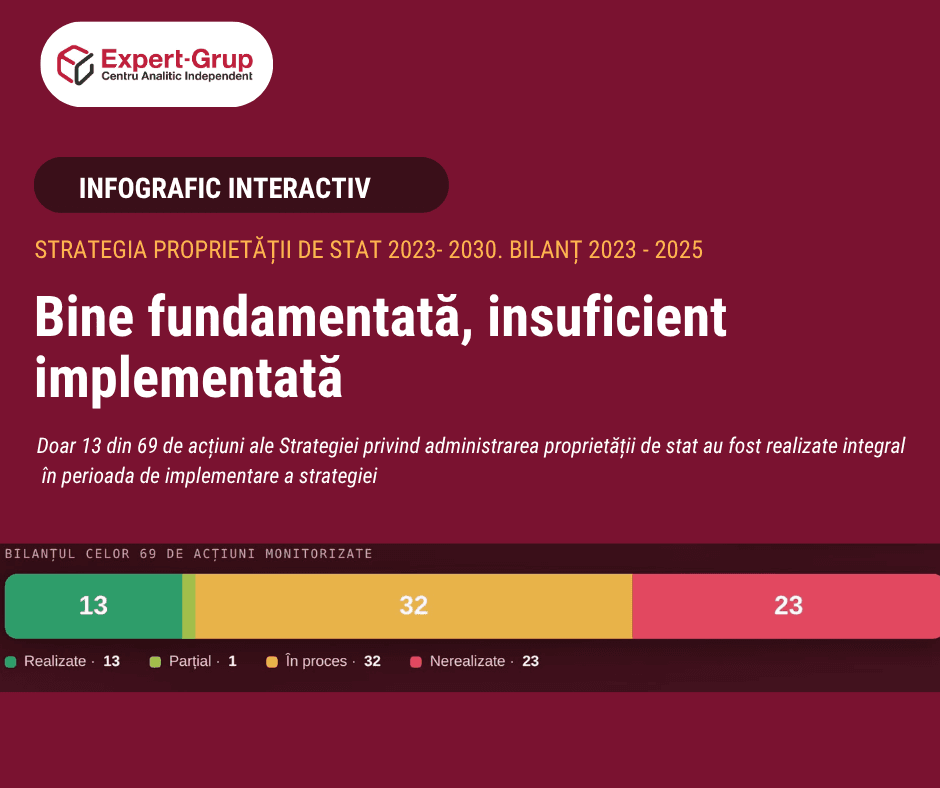
Monitoring the Implementation of the State Property Management Strategy in the Field of State-Owned Enterprises and Joint-Stock Companies
6 July 2026
 Infographic
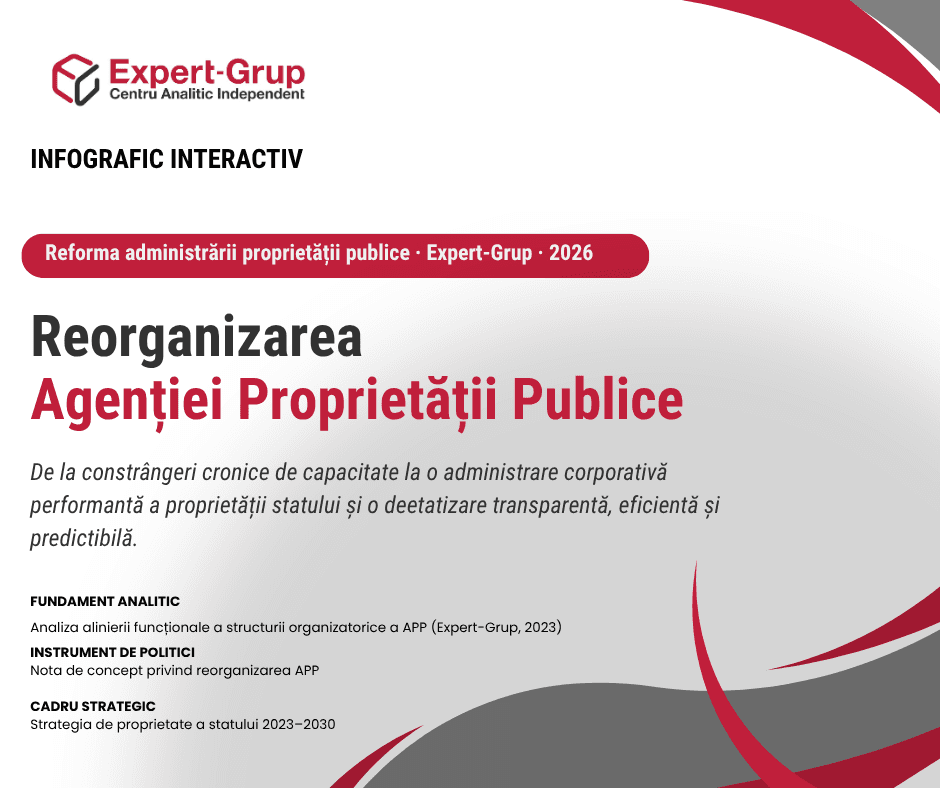
How Should We Reorganise the Public Property Agency?
29 June 2026