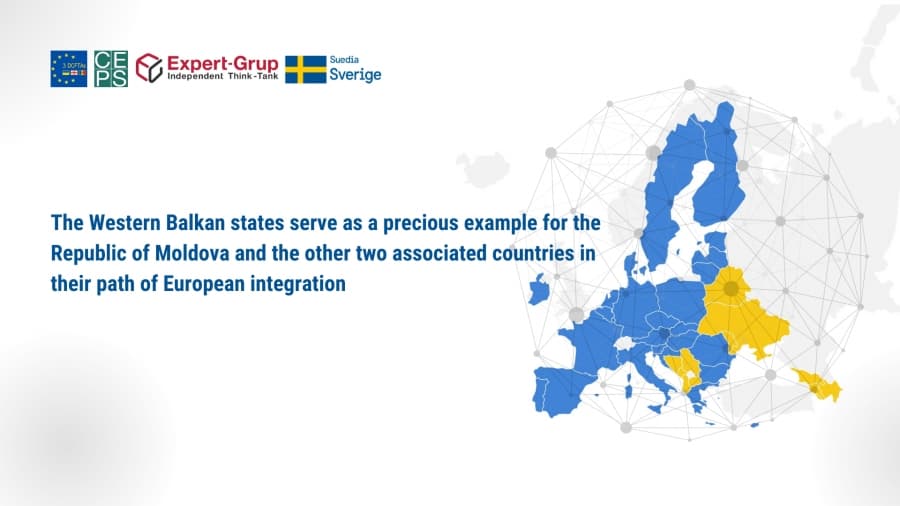
The Western Balkans serve as a precious example for the Rep. of Moldova and the other two associated countries in their path of European integration
These are some of the main conclusions of the speakers from the webinar: “New Momentum” for the European perspective of Moldova – comparisons between the “Associated Trio” and the Western Balkan states, organized by the ”Expert-Grup” Independent Think-Tank and the Center for European Political Studies (CEPS) and based on the research: "Balkan and Eastern European Comparisons: Building a New Momentum for the European integration of the Balkan and Eastern European associated states".
Daniela Cujba, State Secretary, Ministry of Foreign Affairs: “For the Republic of Moldova, the Western Balkans were always a region of special interest due to its progress with regards to EU integration path (...). There is a solid but also converging similarity in terms of commitments and workload, among the Western and the three associated countries, which leads us to an important conclusion that what works for the Western Balkans, works for the countries from the EaP”.
The authors of the research conclude that there is an increasing tendency for the EU to apply the same policy instruments towards both the Balkan states and the associated states in the EaP region, going beyond the content of their Association Agreements with the EU.
The moderator of the webinar Denis Cenusa, an Associated expert at ”Expert-Grup”, and one of the co-authors of the study, underlined that the “New Momentum” study illustrates the advantages of enhancing inter-regional integration processes. The study encourages the associated states to be pro-active, while the EU to be more open to novel the forms of integration of the associated countries.
Siegfried Muresan, Member of the European Parliament: ”The world is changing, that means we have to adapt our tools in order to achieve and move forward the EU integration process. We have to reward the countries that are committed to reforms and EU requirements. The more convincing will be government’s agenda, the more support will come from the EU side”.
As Michael Emerson, Associate Senior Research Fellow, CEPS, says, the change of the situation depends on both the associated countries and the EU: “We propose to pay more attention and concentrate more on where are the problems and the constraints of the EU with regards the fact of accepting more EU members. The Trio should come up with a common proposition towards EU and EaP and our report could serve as a reference and inspiration”.
Daniela Morari, Ambassador of the Republic of Moldova to the EU, considers that an important step for associated states in their common path to European integration was made recently when the Memorandum of the Trio was signed: ”The Trio is interested to build on deepening the cooperation existing already, also to extend on other sectors such as digital, transport and security (...). Getting inspiration from each other and working together, the countries from Trio and Western Balkans would be able to explore more instruments, practices from each other”.
The liberalization of trade-related areas experienced by the Western Balkan states could serve as a reference in what concerns the implementation of the DCFTA components. Iuliana Dragalin, State secretary, Ministry of Economy and Infrastructure, reckons that in the trade area the challenges are of regulatory and enforcing nature, along with the production capacity: “One of the biggest and important challenges is to ensure the maximum use of export quota in the exports to the EU. Another challenge is to make it possible and obtain the right to export poultry meat, B category eggs (...). The Ministry and the responsible authorities are carrying out a series of actions to progress in this direction”.
At the same time, the representatives of the business environment are convinced that the most pressing issues that the authorities must address are the following: digitalization process, food safety requirements, waste management regulations, qualitative education, and not only. „The rule of law is another top priority, the political will that should be tackled and concrete actions are expected so that we could attract investors. Qualitative changes are needed, not just quantitative ones”, says Mariana Rufa, Director of the European Business Association.
The representatives of civil society expect that Moldovan authorities have to prioritize the implementation of the reforms: “The Government should provide instruments and immediate results to make the association agenda more dynamic and practical. The initiated public administration reform should be continued, we need to restore the prestige of public services, we cannot deliver reforms without prepared, well-paid, motivated public servants”, says Adrian Lupusor, Executive Director, ”Expert-Grup” Independent Think-Tank.
Other articles in the same category
See all
24 de primării din Republica Moldova au efectuat o vizită de studiu în Regatul Țărilor de Jos
Au fost desemnați câștigătorii Tulip Business Incubator 3.0: cinci afaceri vor beneficia de granturi în valoare de 5000 euro și mentorat.
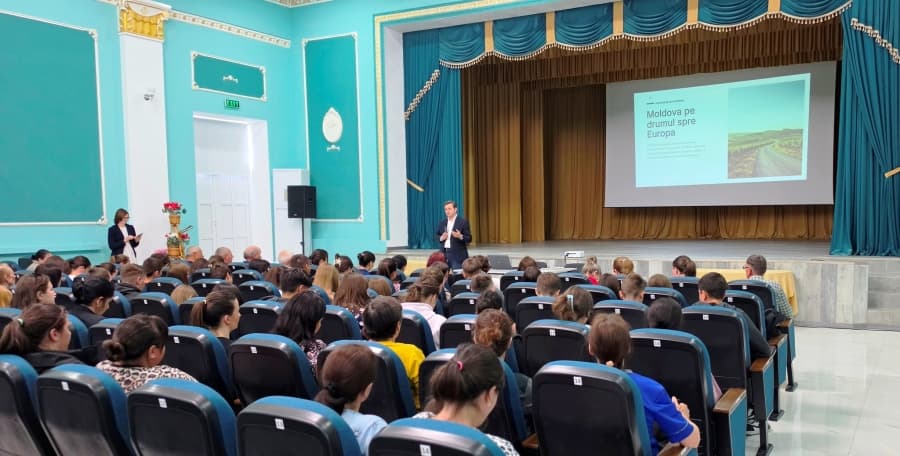
Peste 500 de persoane au participat la discuțiile publice despre integrarea europeană organizate de Expert-Grup în comunitățile locale