Electricity interconnection with Romania - higher energy security for Moldova
Given that about 78.7 per cent of electricity in the Republic of Moldova is imported and the sector is vulnerable because of corruption, abuse and dependence on unreliable providers, and uncompleted liberalisation of the sector, the interconnection with Romania will secure more diverse sources of energy. This will force all market participants to compete with each other, thus providing a higher energy security to the Republic of Moldova, but also a higher pressure from outside on setting fair market rules and institutions, higher transparency and essential regulations to reduce corruption and weaknesses of the sector.
Once the Memorandum was signed between the Government of Romania and Government of the Republic of Moldova in 2014 and the 2030 Moldova Energy Strategy was approved, the discussions about interconnection progressed significantly, having become a political priority, which is supported by international and European financial institutions, who have funded, since 2011, the first feasibility studies on electricity interconnections (EBRD, World Bank).
In practice, the possible interconnections between Romania and the Republic of Moldova can be done in 3 directions - North, Centre and South - based on 3 scenarios: 1. North interconnection or Suceava-Balti OPL (cost - about EUR 132-140 million) - 200 MW; 2. Centre interconnection or Iasi-Ungheni-Straseni OPL (preliminary cost - EUR 257 million, out of which EUR 120 million in Romania and EUR 137 million in Moldova) - 200 MW; and 3. South interconnection or Isaccea (Smardan)-Vulcanesti-Chisinau (cost - initially estimated at EUR 140 million, now estimated at around EUR 194 million, the entire amount in Moldova) - 600 MW. The interest in each of the three interconnections varied and currently the emphasis is on South interconnection (the high-voltage power line Isaccea-Vulcanesti-Chisinau, with a back-to-back facility in Vulcanesti), which is on the EU priority list, with the support of EBRD and Romania (Transelectrica).
According to the authors, the feasibility of constructing electricity interconnections must be viewed pragmatically, both because of financial constraints for regional projects for EU or Romania, but also because the energy sector from Moldova and, particularly, the interconnection projects might be seen by the international partners as a priority that includes Ukraine too, in order to diversify the sources and routes to both countries. Thus, it is likely that an electricity interconnection project could attract private investment or credits. However, it is necessary for the funders and investors to trust the rules of the game and the institutions from the Republic of Moldova.
For these investments to turn true, the study provides a number of recommendations to:
Republic of Moldova
- Introduce a new transparent tender mechanism for the wholesale procurement of electricity by suppliers at regulated rates and by network operators (with strict selection criteria, bids opening, transparency, etc.);
- Expedite the completion, adoption and then enforcement of the draft law meant to strengthen the energy regulator;
- Strengthen the institutional capacity and independence of ANRE;
- Prohibit by law intermediaries with offshore shareholding;
- Negotiate and sign an agreement with Ukraine regarding the infrastructure of the Moldovan energy sector (including the power lines);
- Raise the transparency in the activity of the energy working group from the joint Moldovan-Romanian Intergovernmental Commission;
- Ensure the necessary institutional development of the wholesale electricity market and rules for electricity and gas market;
- Establish and legislate the commercial mechanism ensuring the recovery of investment in energy infrastructure that enhances the safety of power supply.
Romania
- Coordinate the reimbursable support with EU conditionalities;
- Synchronise the investments in Romania and consider the possibility to establish a branch office of S.A. Operator al Pieței de Energie Electrică (OPCOM - JSC Gas and Electricity Market Operator).
European Union
- Condition the direct budget support (of about EUR 50 million);
- Evaluate and communicate publicly, on a regular basis, about the stage of the energy sector reforms;
- Ensure transparent technical coordination between the European financial institutions (European Bank for Reconstruction and Development) and the international ones (World Bank);
- Re-evaluate, together with the Energy Community, the interconnection projects between Romania and the Republic of Moldova.
Other articles in the same category
See all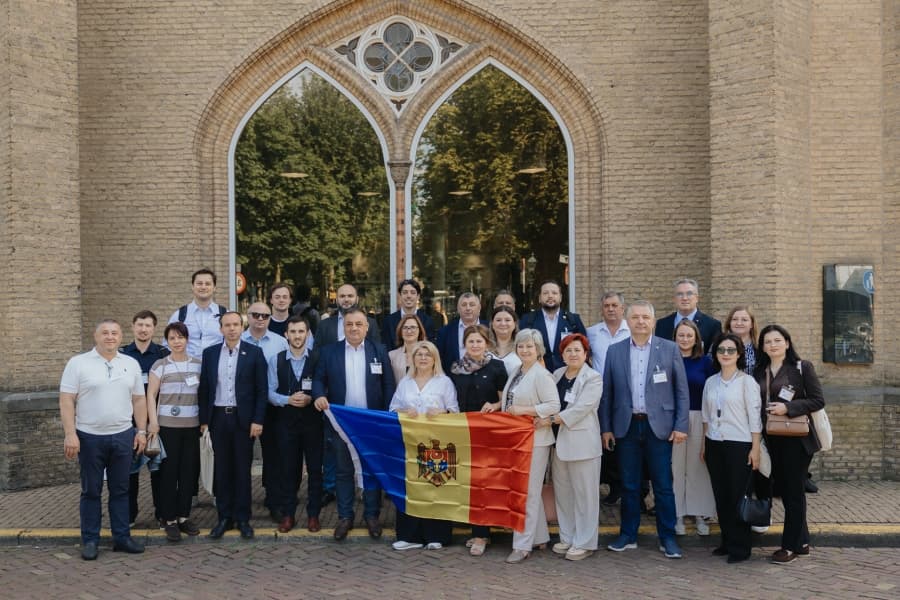
24 de primării din Republica Moldova au efectuat o vizită de studiu în Regatul Țărilor de Jos
Au fost desemnați câștigătorii Tulip Business Incubator 3.0: cinci afaceri vor beneficia de granturi în valoare de 5000 euro și mentorat.
Peste 500 de persoane au participat la discuțiile publice despre integrarea europeană organizate de Expert-Grup în comunitățile locale